Every Arc block hash is a universe
Arc closes a block every half second, and every block carries a hash that cannot be arranged in advance. Those 32 bytes are taken as the initial parameters of a universe and run from the beginning. Most runs form no structure.
Where the universe comes from
The hash is unpacked into 23 values, all of them physical constants: the strength of gravity, the mass of the electron, the density of dark energy, the number of spatial dimensions, and so on. Those 23 values become the starting conditions, and real cosmology carries the run from inflation through to heat death.
It is therefore a deterministic function, not a random generator. The same hash gives the same universe today and in ten years. No parameter is adjusted for appearance; everything comes from the hash.
Most form no structure
The first gate to fail is usually D, the number of spatial dimensions; ours is 3, while hashes commonly yield 9, 14 or 18. At those values gravity is too steep for a planet to hold an orbit or an electron to stay bound to a nucleus, and the universe ends within the first second.
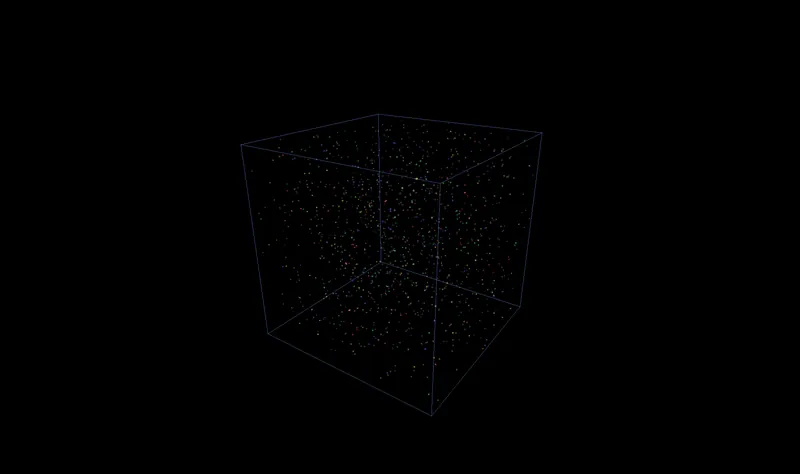
Past that there are further gates: atoms, galaxies, stars, carbon. A run stops at the first gate it fails, and that failure becomes the name of the outcome. Across 1,600 randomly drawn blocks, more than nine in ten stopped at the first gate.
A few do form
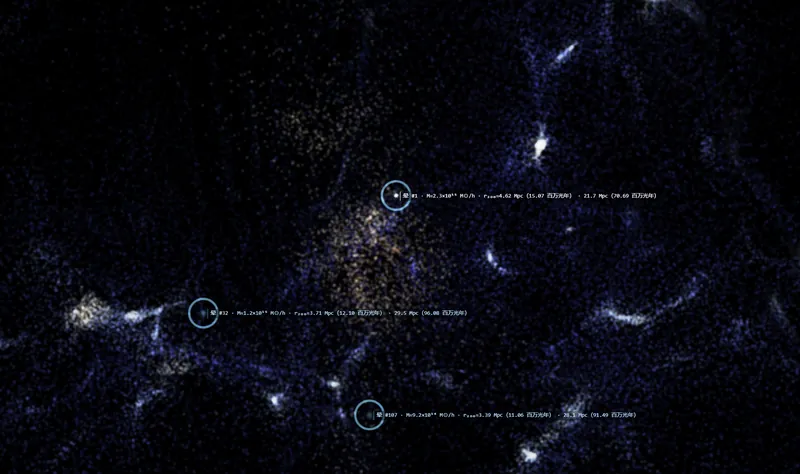
Roughly one in every fifteen to thirty blocks succeeds: galaxies form, stars ignite, carbon and water are present, and the universe lasts long enough. The engine renders those down to a planet surface, and the view can be rotated freely.
How to use it
Open the detonate page and select "latest", or enter a specific block height, such as the block from your birthday or the one your first transaction landed in. A run takes a few seconds. No payment, no wallet, and no limit on how many you view.
A sandbox is also available, where you can adjust the constants yourself and watch the outcome change. Sandbox results never touch the chain and cannot be minted.
1,387 of them
Total supply is 1,387, with no further issuance. The number comes from the age of the universe, 13.787 billion years: one NFT for every ten million years.
887 are free (387 guaranteed slots plus 500 first-come), one per address, gas only. Gas on Arc is paid in USDC, so a mint costs a fraction of a cent and no separate fuel token is required. The remaining 500 are paid; the price will be announced separately, and each address may mint at most 3 of them. The cap of 3 prevents a single address from sweeping the supply; it is not there to create urgency.
A mint is a standard ERC-721 and can be transferred on OpenSea and similar venues, with 5% royalties.
The code
The engine is open source under AGPL-3.0. The derivation of the 23 constants and the rules that decide an outcome are defined in the code: github.com/q3579338/arcbang.
To check that a particular NFT really came out of its block hash, verify provides two commands.